Average Realtor Commission in Iowa: What Sellers and Buyers Should Know in 2026

If you're planning to sell your home in Iowa, one cost tends to catch people off guard: realtor commission. It's usually the single biggest expense in the entire transaction, often adding up to thousands of dollars deducted straight from your sale proceeds at closing.
But here's something a lot of sellers don't realize going in: that commission isn't set in stone. It's not a fixed government rate or a number written into any rulebook. It's simply what you agree to pay your agent, which means it's negotiable.
What's the Average Realtor Commission in Iowa Right Now?
For 2026, you can expect to pay somewhere in the range of 5.7% to 5.9% of your home's sale price in total realtor commission in Iowa. A recent survey of local agents by Clever found that the average real estate commission in Iowa comes in at 5.84%, which is slightly higher than the national average of 5.70%.
How Commission Is Typically Split
That total commission doesn't all go to one person. It's divided into two equal halves: one portion for the listing agent (who represents the seller) and one portion for the buyer's agent (who represents the buyer).
So if you're paying a total commission of around 5.84%, that usually breaks down to somewhere near 2.9% for each side. The listing agent handles pricing your home, marketing it, negotiating offers, and guiding you through closing. The buyer's agent does the same on the other side, helping their client find the right home and negotiate a fair deal.
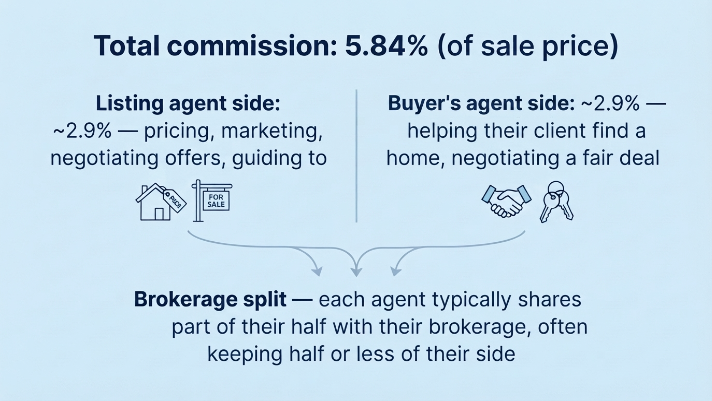
Here's something many sellers don't think about: the agent doesn't keep their entire half. Most agents work under a brokerage, and part of their commission goes back to that brokerage as a split. So if an agent's share is 2.9% of the sale price, they might only take home half of that, or even less, once the brokerage takes its cut. The exact split depends on the agent's experience, their agreement with their brokerage, and how that brokerage structures its commission splits.
For example:
Commission on a $250,000 Home
Total commission: $14,600
Listing agent side: $7,300 → agent may take home ~$3,650–$5,110 after brokerage split
Buyer's agent side: $7,300 → same split applies
What Affects Commission Rates in Iowa

Property location. Where your home is located makes a real difference. In bigger cities like Des Moines or Cedar Rapids, agents may charge closer to 6% of the home's value. In smaller towns or more rural parts of the state, rates tend to run a bit lower, often closer to 5%. This usually comes down to how competitive the local agent market is and how much work is involved in marketing a home in that area.
Home value and price point. Higher-priced homes don't always come with higher percentage rates. In fact, some agents are willing to negotiate a lower percentage on a more expensive home, since the total dollar amount still works out to a solid payday even at a reduced rate. On lower-priced homes, agents may hold firmer to their standard rate since the transaction still takes the same amount of time and effort regardless of price.
Market conditions. Whether it's a buyer's market or a seller's market changes your negotiating position. If homes in your area are selling quickly and agents are competing for listings, you're in a stronger spot to ask for a lower rate. If the market is slower and homes are sitting longer, agents typically have less incentive to budge, since a slower sale means more work on their end for the same commission.
Services included and agent experience. Not all agents offer the same level of service. A more experienced agent with a strong track record, professional photography, staging advice, and a wider marketing reach may justify a higher rate and is more beneficial. A newer agent or one offering a more limited, bare-bones service might be open to a lower commission. It's important to weigh what you're actually getting for the rate you're paying, rather than judging an agent purely on their percentage.
Who Pays the Commission?
Historically, the seller has always been responsible for the payment of the commission of both the buyer's agent and listing agent at closing. The payments do not come from the sellers’ pockets but are instead deducted from the total proceeds of the sale, so it doesn’t have to create another step for the same problem. The commission is split between the buyer and listing agent.
However, in 2024 there was a major lawsuit against the National Association of Realtors (NAR), and it changed some long-standing industry practices. One of the biggest changes: buyer's agent compensation is no longer displayed on MLS listings the way it used to be. This was meant to create more transparent, direct conversations about how buyer's agents get paid, rather than having that cost baked into the listing automatically.
In practice, this means buyers and their agents now need to have a clearer, upfront conversation about compensation, and sellers aren't automatically expected to cover the buyer's agent fee the way they once were. Many sellers still choose to offer this as a concession, since it can make their home more attractive to buyers who don't want to cover their agent's fee separately. But it's no longer just assumed as part of the deal. It's become more of a negotiated point between all parties involved.
Is Realtor Commission in Iowa Negotiable?
Yes. Realtor commission in Iowa isn't set by law or required by the MLS. It's simply an agreement between you and your agent, so there's no rate you're obligated to pay. The percentages mentioned earlier are just averages, not mandated fees.
Sellers tend to have the most leverage in these situations:
- A strong seller's market. When homes are selling fast, agents compete for listings and are more open to a lower rate.
- Higher-priced homes. A lower percentage on an expensive home can still add up to a solid payout, giving agents more room to negotiate.
- A well-prepared seller. Knowing your home's value and local comps signals you're easy to work with, which can help your case.
Can You Buy or Sell a Home in Iowa Without a Realtor?
Given how much commission adds up to, it's natural to wonder if skipping a realtor altogether is worth it. Some sellers, especially those who had experience in selling their properties before and properties sold by owner or FSBO’s, go for this route. This also has some advantages, like not paying an agent’s fee, free marketing, you personally are in charge of negotiations, and the paperwork.
However, the disadvantages are greater in this case, and most people on Reddit share their sentiments, and they emphasized that it would be better to have a realtor whether you are buying or selling because, in a nutshell, it makes the process easier.
Find Your Place by the Water
Wake up to lake views, enjoy peaceful sunsets, and live the lifestyle you’ve always imagined. Explore beautiful homes that capture the spirit of the lakefront dream.
View Our Lakefront ListingsRecent Blog

When a Real Estate Deal Falls Through: Common Breach of Contract Scenarios Explained
A breach of contract happens when someone backs out of a real estate deal, or fails to do something they agreed to do, without a legal reason to do so.
Read MoreWhen a Real Estate Deal Falls Through: Common Breach of Contract Scenarios Explained
Final Walkthrough Checklist: What Buyers Need to Check Before Closing
The last time you, as the buyer, get to walk through the home before it's officially yours. It usually happens within 24 to 48 hours of closing
Read MoreFinal Walkthrough Checklist: What Buyers Need to Check Before Closing
Why Are Some Homes More Expensive in the Same Area?
The reasons usually come down to exact location, views, lot details, and property condition. In places where the local market is shaped by something special, like a lake, those differences can be even bigger than usual.
Read MoreWhy Are Some Homes More Expensive in the Same Area?
How to Win a Bidding War Without Overpaying: Escalation Clauses
An escalation clause is basically an automatic bidding tool for your home offer.
Read MoreHow to Win a Bidding War Without Overpaying: Escalation Clauses
Can I Buy a House With Bad Credit? Here's What You Need to Know
The good news is that bad credit doesn't automatically shut the door on homeownership, it just means you'll likely need to take a slightly different path to get there.
Read MoreCan I Buy a House With Bad Credit? Here's What You Need to Know
Do You Have to Sign a Buyer Broker Agreement in Iowa?
Yes, it is. Since July 1, 2024, Iowa law has required buyers to sign a written agreement with their real estate agent before that agent shows them a property.
Read MoreDo You Have to Sign a Buyer Broker Agreement in Iowa?
Can I Buy or Make an Offer on a House Without Earnest Money?
If you're putting together an offer on a house and wondering whether you can skip the earnest money, the short answer is yes, technically. There's no law that says you have to include it. But in practice, an offer without earnest money is almost always turned down.
Read MoreCan I Buy or Make an Offer on a House Without Earnest Money?
How to Make an Offer on a House: A Step-by-Step Guide
Making an offer on a house involves submitting a written proposal that includes your price and purchase terms for the seller to review.
Read MoreHow to Make an Offer on a House: A Step-by-Step Guide
Can I Back Out From a Purchase Agreement?
Yes, you can back out from a purchase agreement, but what happens next depends on where you are in the process.
Read MoreCan I Back Out From a Purchase Agreement?
Are Homes Usually Inspected Before Listing?
No, homes are not usually inspected before listing. In most real estate transactions, the home inspection takes place after a buyer submits an offer and the seller accepts it. At that point, the buyer typically hires a professional inspector to evaluate the property's condition and identify any issues that may affect the purchase.
Read MoreAre Homes Usually Inspected Before Listing?
Can I Make an Offer Without a Real Estate Agent in Iowa?
The answer is yes, you can make an offer on a house without a real estate agent in Iowa. While many buyers choose to work with an agent during the home buying process, state law does not require you to have one when submitting an offer. This means you can represent yourself and communicate directly with the seller or the seller's representative if you decide to do so.
Read MoreCan I Make an Offer Without a Real Estate Agent in Iowa?
What Is the 3-3-3 Rule in Real Estate? A Guide to Homebuying
The 3-3-3 rule means having three months of emergency savings, saving an additional three months' worth of mortgage payments, and getting three property evaluations before buying a home.
Read MoreWhat Is the 3-3-3 Rule in Real Estate? A Guide to Homebuying