What Is the 3-3-3 Rule in Real Estate? A Guide to Homebuying

Before you buy a home, it's smart to check off three things:
- 3 months of emergency savings set aside
- 3 months of mortgage payments saved on top of that
- 3 property evaluations before you commit to a purchase
The rule is simple; its aim is to help buyers protect their hard earned money before making any decision pertaining to buying a house or property. This is not something set in stone but a simple suggestion of Aaron Jones, a licensed real estate advisor hailing from Okoboji, Iowa. Setting aside a financial margin, such as several months of mortgage will mitigate uncertainties related to anything financial should there be drastic changes in your income or emergencies. Multiple property evaluations will also prevent you from making rushed decisions that you might regret later on.
First 3: Have Three Months of Emergency Savings Before Buying a Home
Many buyers, especially first-time home buyers, make the mistake of just saving for the down payment and closing costs. Although there is nothing wrong with doing just that, it is just that when it comes to the 3-3-3 rule, it completely ignores the financial cushion that it advocates.
Imagine if at first, everything goes right, and after a few months, you are hit with an emergency, or worse, you lose your job. Your major milestone, which was buying your dream home, now becomes your biggest financial hurdle. You won’t just be losing your home, but you also lose all the years you spent saving to acquire one. But applying the 3-3-3 rule will prevent this, as you will have months of time to figure things out.
What Counts as an Emergency Fund?
An emergency fund is money set aside specifically for unexpected situations that could affect your financial stability. This money should be easy to access and kept separate from funds intended for your down payment, moving expenses, or other planned costs.
Examples of emergencies may include:
- Unexpected medical bills
- Job loss or reduced income
- Major car repairs
- Emergency home repairs
- Temporary family emergencies
What it's for
A safety net for the unexpected — job loss, medical bills, urgent repairs. Money you can reach for without a second thought when life goes sideways.
What it's not for
How to Calculate Three Months of Living Expenses
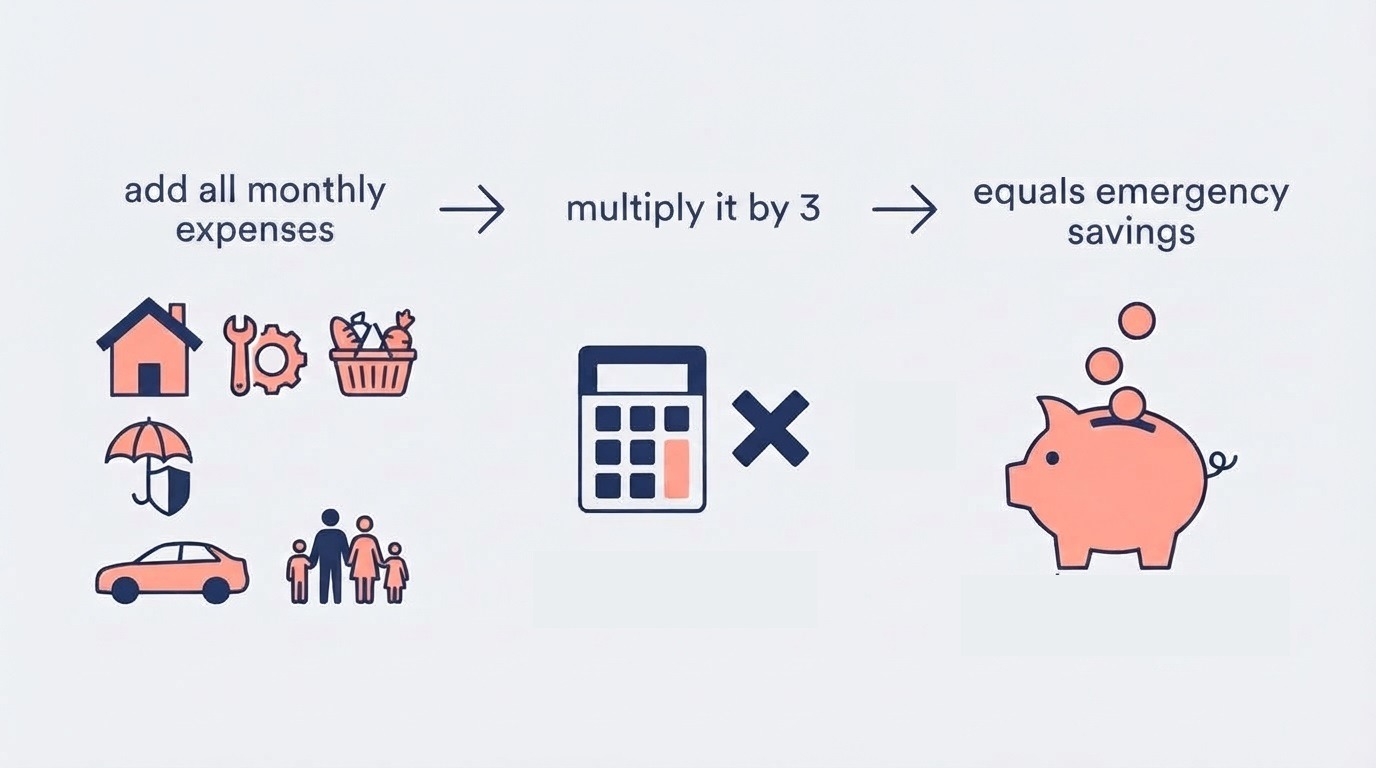
To determine how much emergency savings you should have, start by calculating your essential monthly expenses. Focus on the costs you would still need to pay if your income suddenly stopped.
These expenses may include:
- Mortgage or rent payments
- Utilities
- Groceries
- Insurance premiums
- Transportation costs
- Minimum debt payments
- Childcare expenses
Upon identifying the various costs for monthly expenses for essentials, get the total of the amount and then multiply it by three. For example, if the total for monthly expenses is $4,000, then the amount you need for the 3-3-3 rule would be $12,000.
You can have more than 3 months' worth of emergency savings depending on how it fits your circumstances. If you fear that something big might happen in the near future then it would be best to save more. These situations are the reasons you might need to dip into your savings. You might wonder how emergency funds turned into living expenses, but the idea is to determine how much you need or the cost of keeping your regular life running while you try to get back on your feet for a few months.
Second 3: Save Three Months of Mortgage Payments
The second part of the 3-3-3 rule encourages buyers to save an amount equal to three months of mortgage payments before purchasing a home. While this may sound similar to having an emergency fund, the two serve different purposes. An emergency fund is meant to cover your overall living expenses during a financial hardship, while a mortgage cushion is specifically intended to help you keep up with your housing payments if unexpected challenges arise.
Having this extra reserve can make the transition into homeownership less stressful and provide additional financial security during the first few years of owning a home.
What This Part of the Rule Means
The purpose is simple: if you experience a temporary financial setback after buying the home, you'll have funds available to help keep your mortgage current while you work through the situation.
Why a Mortgage Cushion Matters
Because once again, most buyers think that the expenses end once the sale is complete, but in fact, they do not. Realistically, people would normally encounter having to purchase furniture, maintenance issues, appliances, and other costs that may come later that weren't part of your original budget.
So instead of worrying about the uncertainties that might follow, having 3 months' worth of mortgage reserve will help reduce stress in making your next payment. This will also prevent you from making additional loans, whether from friends, credit cards, or bank loans with high interest that are surely going to make your life even harder.
Expenses Included in Your Monthly Mortgage Payment
Common expenses may include:
- Principal, which reduces the amount you owe on the loan
- Interest charged by the lender
- Property taxes
- Homeowners insurance
- Mortgage insurance, if required
- Homeowners association (HOA) fees in some communities
Third 3: View Three Similar Properties Before You Buy
The final part of the 3-3-3 rule is not about saving money anymore, finally! This part is all about making sure you are getting the best value for your money. This rule encourages you to look at at least 3 properties with similar features, size, and location before deciding on a home. In this way, you are helping yourself make a more informed decision.
This rule allows you to better understand local market conditions, compare features, and identify potential pros and cons, and you can start this with only using your phone and looking at listings. If you wish to have a private viewing, you can also do so.
Not ready to buy yet? That's okay. A quick call with a local Okoboji realtor can help you plan your timeline with confidence.
Call (712) 336-4967Why Looking at Only One Home Can Be Risky
Making a sound decision will not be possible without comparing properties. You wouldn’t know if the house you are interested in is priced right or fairly or even whether it fits your needs.
To make an informed decision when it comes to buying a home, these questions must be answered first before making the next move:
- Is this home priced competitively?
- Are similar homes offering more features?
- Is the location as desirable as other nearby neighborhoods?
- Are there better options within the same budget?
What to Compare When Viewing Similar Properties
Not every home will be identical, but comparing properties with similar characteristics can provide valuable insights.
Consider comparing factors such as:
- Square footage
- Number of bedrooms and bathrooms
- Lot size
- Property condition
- Neighborhood amenities
- School districts
- Commute times
- Recent upgrades or renovations
- Asking price
This part may require you to do more on your part, but hiring a good real estate agent can do rule number 3 for you while you do other important things. You can even have realtors do everything while you are in another state.
Find Your Place by the Water
Wake up to lake views, enjoy peaceful sunsets, and live the lifestyle you’ve always imagined. Explore beautiful homes that capture the spirit of the lakefront dream.
View Our Lakefront ListingsRecent Blog

When a Real Estate Deal Falls Through: Common Breach of Contract Scenarios Explained
A breach of contract happens when someone backs out of a real estate deal, or fails to do something they agreed to do, without a legal reason to do so.
Read MoreWhen a Real Estate Deal Falls Through: Common Breach of Contract Scenarios Explained
Final Walkthrough Checklist: What Buyers Need to Check Before Closing
The last time you, as the buyer, get to walk through the home before it's officially yours. It usually happens within 24 to 48 hours of closing
Read MoreFinal Walkthrough Checklist: What Buyers Need to Check Before Closing
Why Are Some Homes More Expensive in the Same Area?
The reasons usually come down to exact location, views, lot details, and property condition. In places where the local market is shaped by something special, like a lake, those differences can be even bigger than usual.
Read MoreWhy Are Some Homes More Expensive in the Same Area?
How to Win a Bidding War Without Overpaying: Escalation Clauses
An escalation clause is basically an automatic bidding tool for your home offer.
Read MoreHow to Win a Bidding War Without Overpaying: Escalation Clauses
Can I Buy a House With Bad Credit? Here's What You Need to Know
The good news is that bad credit doesn't automatically shut the door on homeownership, it just means you'll likely need to take a slightly different path to get there.
Read MoreCan I Buy a House With Bad Credit? Here's What You Need to Know
Do You Have to Sign a Buyer Broker Agreement in Iowa?
Yes, it is. Since July 1, 2024, Iowa law has required buyers to sign a written agreement with their real estate agent before that agent shows them a property.
Read MoreDo You Have to Sign a Buyer Broker Agreement in Iowa?
Can I Buy or Make an Offer on a House Without Earnest Money?
If you're putting together an offer on a house and wondering whether you can skip the earnest money, the short answer is yes, technically. There's no law that says you have to include it. But in practice, an offer without earnest money is almost always turned down.
Read MoreCan I Buy or Make an Offer on a House Without Earnest Money?
Average Realtor Commission in Iowa: What Sellers and Buyers Should Know in 2026
You can expect to pay somewhere in the range of 5.7% to 5.9% of your home's sale price in total realtor commission.
Read MoreAverage Realtor Commission in Iowa: What Sellers and Buyers Should Know in 2026
How to Make an Offer on a House: A Step-by-Step Guide
Making an offer on a house involves submitting a written proposal that includes your price and purchase terms for the seller to review.
Read MoreHow to Make an Offer on a House: A Step-by-Step Guide
Can I Back Out From a Purchase Agreement?
Yes, you can back out from a purchase agreement, but what happens next depends on where you are in the process.
Read MoreCan I Back Out From a Purchase Agreement?
Are Homes Usually Inspected Before Listing?
No, homes are not usually inspected before listing. In most real estate transactions, the home inspection takes place after a buyer submits an offer and the seller accepts it. At that point, the buyer typically hires a professional inspector to evaluate the property's condition and identify any issues that may affect the purchase.
Read MoreAre Homes Usually Inspected Before Listing?
Can I Make an Offer Without a Real Estate Agent in Iowa?
The answer is yes, you can make an offer on a house without a real estate agent in Iowa. While many buyers choose to work with an agent during the home buying process, state law does not require you to have one when submitting an offer. This means you can represent yourself and communicate directly with the seller or the seller's representative if you decide to do so.
Read MoreCan I Make an Offer Without a Real Estate Agent in Iowa?